
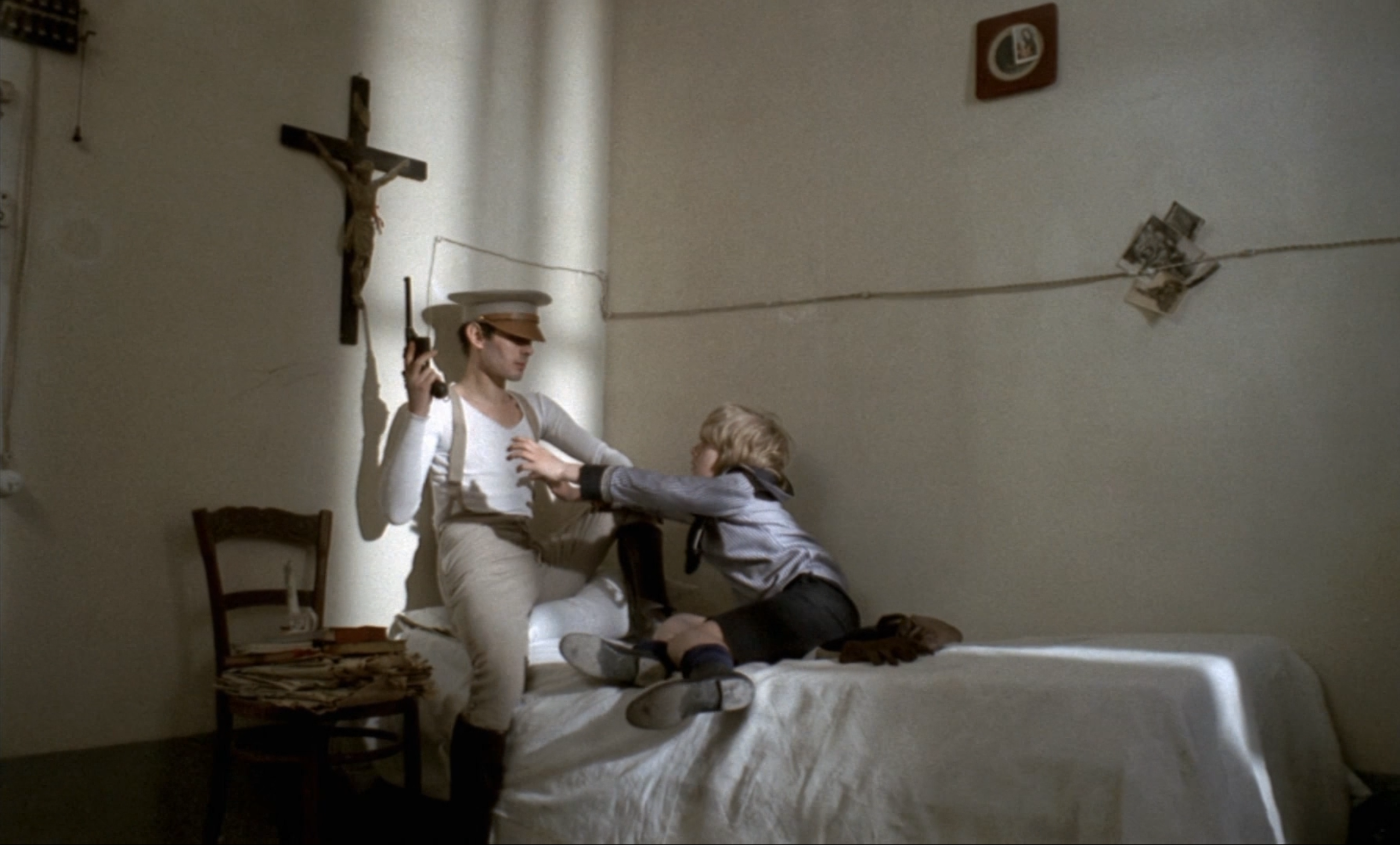
As I stand in the middle of my research about male bodies in the Italian cinema during the years of the lead for my master’s program, I start writing a few resumes of what my thesis is going to look like for academic purposes. While I still have a lot of research to do, I’d like to share some of my perspectives and intakes in a non-academic way for people like me, who are interested in the subject.
When people talk about studies of Italian cinema, they usually refer to Italian neorealism, and genre films such as the giallo, the poliziotteschi, the spaghetti western, and the commedia all’italiana. When people talk about Italian filmmakers, the most mentioned are Fellini, Pasolini, Visconti, and Scola. There aren’t many studies, however, that are interested in looking at the bodies represented in these films. Maybe because, superficially, what we see when we look at Italian cinema in general are typical sexist stereotypes that perpetuated the Italian conservative culture throughout the 20th Century. Laura Mulvey’s Visual Pleasure and Narrative Cinema‘s text about how cinema was constructed through a male gaze collaborates with this reading. But by trying to reverse this gaze to the male bodies in Italian cinema, we can discover many interesting things.

“Bicycle Thieves (1948)” by Vittorio De Sica
Being the country that produced and watched the most films after the United States, the history of Italian cinema is formed by a rich and beautiful path that reflects its culture and society through different film genres and important cinematic moments. Inspired by the May 68 protests, the economic decline of the end of an economic miracle, the legalization of abortion and divorce, and a strong left opposition to the Christian Democrats in politics, Italy enters the 70s decade as a period of crisis, also known today as the Years of the Lead.
Being a period marked by political violence and social unrest, the Italian cinema during the Years of the Lead reflected this crisis through movies that represented a pessimistic and fragmented society that felt insecure towards political institutions, while living an economic crisis, the lack of security in the big cities, and high levels of poverty caused by millions of migrations from rural areas to urban ones. It’s during these years that Pier Paolo Pasolini, Luchino Visconti, and Bernardo Bertolucci released Teorema (1968), Death in Venice (1971), and The Conformist (1970). More than being important movies in film history, these three directors and films confront the spectator to look for the first time in Italy the male body as an object of sexual desire, and how this homoerotic look can represent Italy’s social and political unrest through the male bodies of its protagonists.

“Teorema (1968)” by Pier Paolo Pasolini
Despite Italian cinema generally focusing on male straight characters that appear in regular narrative forms constructed under the male gaze, we can see how the representation of the male figure is complex and problematic since Italian neorealism. Studies show how the male melodrama, or “male weepies”, can be found in the narrative of Bicycle Thieves (1948) by Vittorio de Sica, by showing a man incapable of sustaining his family and turning to crime after his bicycle is stolen.
Throughout the 50s, the figure of the vitelloni is immortalized through Fellini’s I Vitelloni (1953), the name given to a post-war generation of young middle-class men who refused to face responsibilities of work and marriage. The same portrayal can be found in movies such as The Big Night (1959) by Mauro Bolognini, and Abandoned (1955) by Francesco Maselli. They all tell stories of a group of young male friends dealing with the pressures of adulthood and its responsibilities, and the lack of commitment towards Italian cultural values of manhood.

“The Big Night (1959)” by Mauro Bolognini
In the 60s, the commedia all’italiana made fun of the different cultural values between the rich modern north and the poor conservative south through the inepto, an Italian anti-hero whose masculinity is performed visually and verbally through the social sphere, but it’s formed through contradictions due to conservative Italian values. These male figures can be found in incredible films such as Handsome Antonio (1960) by Mauro Bolognini, which tells the story of a man who can’t officialize his marriage because he is impotent; and Mafioso (1962) by Alberto Lattuada, which follows a southerner who after getting married and rich in the north, travels back to the south, facing hilarious dillemmas. These contradictions become even more problematic when compared to different regions of the country, as Pier Paolo Pasolini puts it in the beautiful documentary Love Meetings (1964), where the director travels through Italy to question people about sexuality, prostitution, homosexuality, and the legalization of divorce.

“Love Meetings (1964)” by Pier Paolo Pasolini
When we enter the Years of the Lead in the 70s, the male body enters a crisis. If the Italian male identity in cinema had already been presented as fragile and problematic, the Italian male loses all his referential identity through a failed economic miracle, the legalization of divorce and abortion, political and social terrorism from left-wing and right-wing groups, and the feminist and gay movements. The cinematic response to this is the field study of my research.
It was right under the Years of the Lead that the most important Italian film genres came to be. The giallo, for example, usually portrays the male body as a hidden serial killer, with deep psychological and sexual problems, through a narrative that mostly doesn’t make much sense. Dario Argento is probably the most famous name when it comes to this genre, with his impeccable Three Mothers and Animals’ Trilogy.
In the spaghetti western, the values of the main hero are way more ambiguous, cynical, and violent in comparison to the heroes of the American westerns, in which the frontiers of the good and the bad are extremely well defined. Not only that, the homosocial interactions of the classic Western create a space for homoerotic tension through spaghetti western films such as A Bullet for the General (1967) by Damiano Damiani, Requiescant (1967) by Carlo Lizzani, and the famous gay rape scene in Django Kill… If You Live, Shoot (1967) by Giulio Questi.

“Django Kill… If You Live, Shoot (1967)” by Giulio Questi
The poliziottesco, on the other hand, more than portraying the current violence and scandals that were happening in the big metropolis, they also told stories in which the main characters were the criminals themselves, or police officers who were forced to turn to criminal activities to do justice with their own hands, revealing a corrupt structure within governmental institutions. Along with the first Django movie, Franco Nero became famous for his appearance in many films from this genre, along with fundamental titles from Francesco Rosi and Elio Petri, such as The Mattei Affair (1972), Illustrious Corpses (1976), Investigation of a Citizen Above Suspicion (1970), and Todo Modo (1976).

“Todo Modo (1976)” by Elio Petri
And lastly, we return to talk about Pasolini and Visconti and how their redirection of the spectator’s eyes towards the male body and its homoerotic and sensual approach make their characters enter a catalytic state that will bring them to ruin. This happens more explicitly in Death in Venice (1971), where the male body goes through a process of moral and physical decay once it encounters the personification of beauty and perfection in the face and body of a young boy named Tadzio. In Salò or the 120 Days of Sodom (1975), Pasolini uses young male bodies to go through pleasure, violence, and humiliation to portray not only Italy’s fascist past, but also to condemn Italy’s social, political, and economic state of the Years of the Lead.

“Salò or 120 Days of Sodom (1975)” by Pier Paolo Pasolini
While this is an ongoing research that will take academic forms, we can say that despite the heteronormative and patriarchal narratives that dominate Italian cinema throughout most of the 20th Century, we can see that there are solid readings regarding the male body as a reflection of social and political unrest that affected Italy during the Years of the Lead. I hope this introduction made you more interested in the history of Italian cinema and more interested in the mentioned directors and titles. A full list of films that inspired my research and that are referenced can be found here.
Featured image: The Conformist (1970) by Bernardo Bertolucci.
Some fonts: History of the Italian Cinema (Peter Bondanella), Beyond the Latin Lover (Jacqueline Reich).